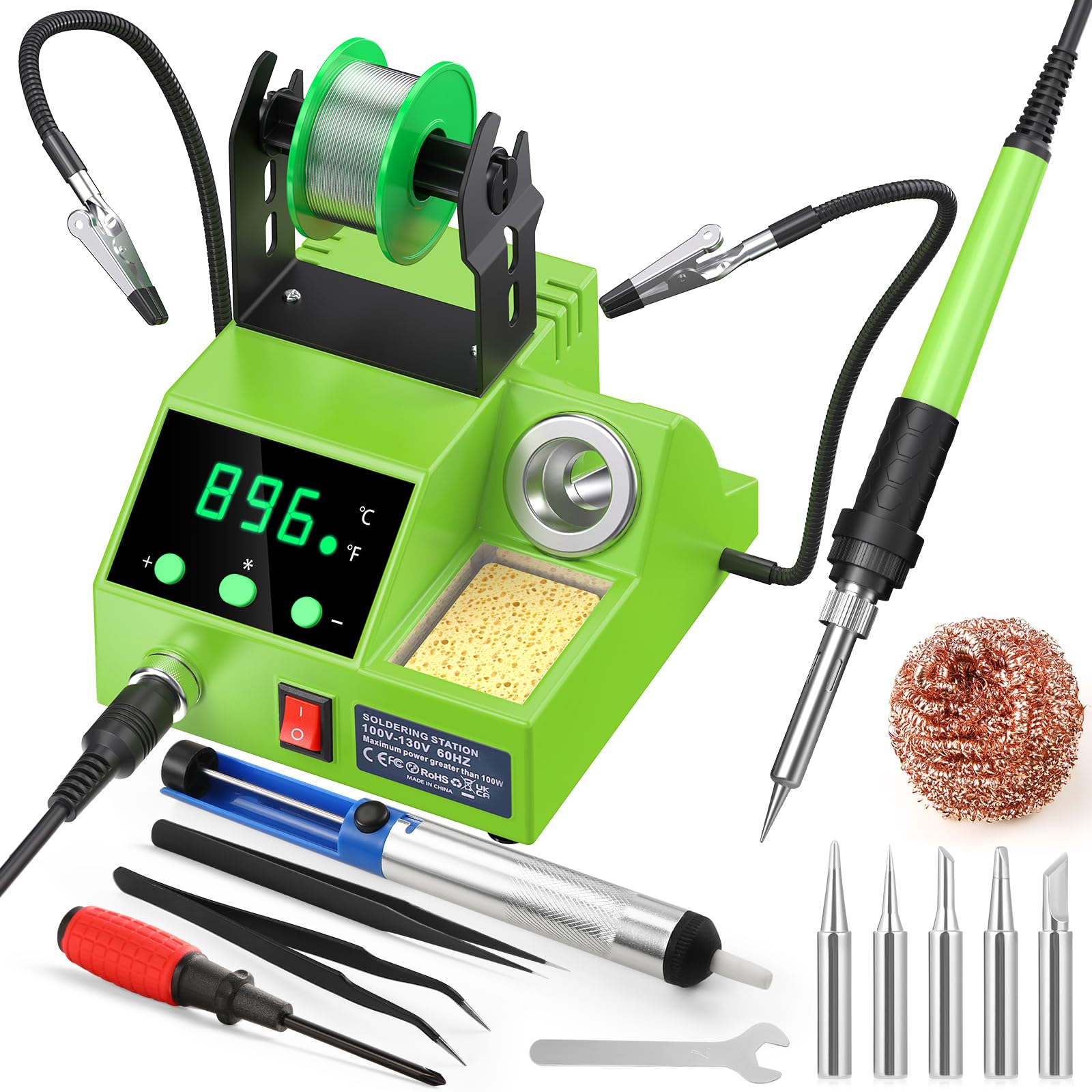
WEP 882D 2-IN-1 Soldering & Hot Air Rework Station Review
Maintaining a dedicated electronics workbench requires tools that deliver precise thermal control, predictable performance, and versatile functionality without taking up an excessive amount of surface area. For electronics hobbyists, DIY circuit board repairers, and technicians working on surface-mount technology (SMD), balancing equipment needs often means choosing between separate single-purpose devices or consolidated stations. The WEP 882D 2-IN-1 Soldering Iron Station and SMD Hot Air Rework Station addresses this balance by integrating two core bench tools into a single, compact unit designed specifically for standard North American power configurations.
By unifying a temperature-controlled soldering iron and a high-volume hot air rework gun into one central station, the WEP 882D eliminates the need for standalone main units that clutter your workspace. Both power channels feature individual digital LED displays, independent power switches, dedicated push-button temperature controls, and an adjustable air volume dial for the hot air rework handle. Operating on 110-127V USA voltage specifications, this station is tailored for immediate deployment in American home workshops, garages, and professional repair benches.
Out of the box, the WEP 882D is delivered as an all-in-one starter bundle designed to get users working immediately. Alongside the dual-function station body, the unit includes two spools of solder wire, five distinct soldering tip profiles (I, B, K, 3.2D, and 3C), three hot air nozzles, a brass wool tip cleaner with a holder, a manual desoldering pump, and precision tweezers. Backed by a strong customer feedback history—boasting a 4.5 out of 5-star rating across more than 1,600 user reviews—and supported by dedicated 1-year USA technical support, this 2-in-1 station stands as a comprehensive solution for diverse electronics repair tasks.
Key Features
- Dual-Function 2-IN-1 Architecture: Combines a precision soldering iron station and an SMD hot air rework station within a super compact main body, featuring independent LED displays, individual power switches, digital temperature controls, and variable air volume adjustment.
- Built-in PID Temperature Control: Integrates a microchip PID program that actively monitors and adjusts temperatures to deliver precise thermal stability for both channels during continuous operation.
- Wide Operating Temperature Ranges: Provides fully adjustable temperature output ranging from 392°F to 896°F for the soldering iron channel and 212°F to 896°F with variable airflow for the hot air rework channel.
- Smart Energy & Life-Extension Modes: Features an automated sleep mode for the soldering iron when resting in its holder, a safety standby mode for the hot air gun, and an automatic shutdown routine to reduce component wear and conserve power.
- User-Centric Customization: Supports seamless temperature unit conversion between Celsius and Fahrenheit (°C-°F Conversion) alongside a digital temperature calibration function to maintain long-term accuracy.
- Complete Starter Accessory Bundle: Includes 2 spools of solder wire, 5 soldering tip shapes (I, B, K, 3.2D, 3C), 3 hot air reduction nozzles, a brass wool tip cleaner, a manual desoldering suction pump, and anti-static precision tweezers.
- US Voltage Compatibility & Support: Designed strictly for 110-127V USA electrical outlets and backed by 1-year USA technical support with 24-hour customer assistance.
Performance
Thermal stability and precise heat delivery are critical when working with modern printed circuit boards (PCBs). Modern lead-free and leaded solders require consistent heat application to prevent cold joints, thermal shock to sensitive silicon, or trace delamination on delicate circuit boards. The WEP 882D delivers high performance in this area through its built-in Proportional-Integral-Derivative (PID) control program. This micro-controller system continuously samples tip and heating element temperatures, making split-second corrections to maintain exact thermal delivery under varying workloads. When bringing the soldering iron into contact with large copper ground planes, the PID loop responds by delivering the necessary thermal compensation without severe temperature drops.
The dual digital interface enhances operational efficiency on the bench. Having individual LED displays and dedicated power switches for both the soldering iron and the hot air gun allows users to run either tool independently or both simultaneously. If a rework job requires localized pre-heating via hot air while applying fine solder to adjacent surface-mount pins, both channels operate side-by-side without mutual interference. The soldering iron channel offers a broad temperature range of 392°F to 896°F, making it equally capable of fine wire soldering, through-hole component installation, or heavy-duty connector soldering. Meanwhile, the hot air rework channel spans 212°F to 896°F paired with a variable air volume adjustment knob, enabling controlled airflow for delicate SMD reflow, chip desoldering, or heat-shrink tubing applications.
In practical bench environments, equipment safety and thermal longevity are top priorities. The WEP 882D incorporates intelligent sleep and standby protocols designed to minimize oxidation and extend component life. When the soldering iron remains seated in its holder for an extended period, the station automatically initiates its sleep mode, lowering the iron's temperature to prevent the tip from oxidizing prematurely and burning away thin solder coatings. For the hot air rework gun, placing the handpiece into its dedicated holder automatically triggers standby mode. The system routes air through the handle to safely cool the internal heating element down to a safe threshold before shutting off airflow completely. This automated process prevents thermal stress inside the heating core, significantly prolonging the functional lifespan of the hot air element while reducing safety hazards in busy work environments.
Furthermore, the unit features a digital calibration mode and a simple °C-to-°F unit conversion function. Over hundreds of hours of thermal cycles, all heating elements naturally experience subtle resistance shifts that can lead to temperature drift. The built-in calibration feature allows users to verify actual tip output with an external thermometer and fine-tune the digital readout directly on the station. This ensures that when the LED display reads a specific temperature, the physical output at the soldering tip or hot air nozzle matches precisely, fulfilling the demands of high-accuracy electronic repair.
Build Quality
The overall build quality of the WEP 882D reflects a modern, space-conscious engineering approach. By housing two independent power supplies and control circuits into a compact main chassis, WEP has minimized the physical footprint required on a workbench. The front panel layout is organized logically: clear dual LED displays sit at eye level, flanked by intuitive push-button controls for digital temperature adjustment. Separate, high-visibility power switches prevent accidental startup of the unneeded channel, while a tactile rotary knob allows fine tuning of the hot air fan velocity.
The accessories supplied with the WEP 882D kit reflect a complete setup designed for immediate, reliable use out of the box. The package includes five specialized soldering tip geometries to tackle various soldering tasks:
- I Tip: An ultra-fine conical tip designed for precise detail work, micro-soldering, and working with tightly packed SMD pins.
- B Tip: An all-purpose conical tip that provides balanced heat transfer for general electronic assembly and through-hole soldering.
- K Tip: A versatile knife-shaped tip excellent for drag soldering multiple SMD leads simultaneously and clearing solder bridges.
- 3.2D Tip: A sturdy chisel tip that offers a wider contact area for effective heat transfer onto thick wire leads and larger ground pads.
- 3C Tip: A bevel/slanted tip capable of holding small pools of solder, ideal for drag soldering pin headers and discrete components.
Maintenance and desoldering tools included with the station also emphasize practical bench utility. The brass wool tip cleaner removes excess solder and tip oxides without requiring water. Unlike traditional wet sponges, which drop tip temperatures abruptly and subject plating to severe thermal shock, dry brass wool cleans the iron surface cleanly without cooling the tip. The manual desoldering pump provides strong suction for clearing molten solder from through-hole pads, while the included precision tweezers assist in holding tiny surface-mount components during hot air reflow or hand soldering. Additionally, three distinct hot air reduction nozzles allow users to concentrate airflow to match the exact size of IC chips or SMD packages without blowing heat across surrounding board components.
It is important to emphasize the electrical parameters of this unit: the WEP 882D is rated specifically for 110-127V USA specifications. It is designed to run safely on standard 120V household current found throughout the United States. Connecting this unit to a 220V power socket will cause immediate damage to the internal electronics and heating elements. Operating the unit within its rated 110-127V window ensures stable performance, rapid heat-up times, and safe power delivery.
Who Should Buy It
The WEP 882D 2-IN-1 Rework Station is engineered to serve a wide range of users within the North American electronics community. Its combination of affordable dual functionality, complete accessory bundle, and digital safety features makes it suitable for several key user groups:
- Electronics Hobbyists & DIY Enthusiasts: Makers building custom micro-controller projects, repairing household audio gear, or assembling DIY drone electronics will appreciate having both soldering and hot air rework capabilities in a single compact package without buying multiple standalone tools.
- SMD & PCB Repair Technicians: Technicians tasked with component-level circuit board repairs, cell phone screen/board fixes, or automotive module refurbishments benefit from the stable PID temperature control and the range of hot air nozzles and tip shapes.
- Makerspaces & Educational Labs: High school STEM labs, college engineering workshops, and community makerspaces looking for user-friendly, standardized 110-127V equipment with automated safety features (such as iron sleep mode and hot air auto-standby) will find this station both accessible and safe for multi-user environments.
- Beginners Upgrading from Basic Irons: Users moving away from fixed-wattage entry-level wall-plug irons will gain immediate advantages from digital temperature readouts, variable heat settings, and the complete set of included maintenance accessories.
Pros
- Space-Saving 2-in-1 Design: Combines a full-featured soldering station and an SMD hot air rework station inside a single compact body, freeing up vital workbench real estate.
- Active PID Temperature Control: Delivers precise thermal stability and fast recovery times for both channels across broad operating ranges (392–896°F for soldering; 212–896°F for hot air).
- Comprehensive Starter Kit: Includes 5 versatile soldering tips (I, B, K, 3.2D, 3C), 3 hot air nozzles, 2 spools of solder wire, a brass wool tip cleaner, a desoldering pump, and precision tweezers.
- Advanced Longevity & Safety Features: Built-in soldering iron sleep mode, automated hot air standby cooling, automatic shutdown, and digital temperature calibration prolong heating element life.
- Independent Controls & Dual Displays: Separate power switches and twin digital LED readouts allow each channel to be monitored and operated independently or simultaneously.
Cons
- 110-127V USA Only: Strictly engineered for North American power standards; cannot be plugged directly into 220V electrical outlets without damaging the internal circuitry.
- Dual Cable Management: Having both a soldering iron handle and a hot air handpiece connected to one main console requires thoughtful wire routing on small workbenches.
- Learning Curve for Advanced Functions: Utilizing temperature calibration and balancing hot air velocity for delicate SMD rework requires initial practice for absolute beginners.
Buying Guide
When selecting a soldering and rework station for your workbench, several factors determine whether a tool meets your technical needs. Understanding these specifications ensures you select an instrument that delivers reliable performance, safety, and longevity for your electronic projects.
1. Single-Function vs. 2-IN-1 Integrated Stations
Traditional workbenches often feature separate units for hand soldering and surface-mount rework. While individual units offer modularity, they require double the outlet connections and occupy twice as much desk space. An integrated 2-in-1 station like the WEP 882D consolidates the transformer core and control logic into a single chassis. This setup provides dedicated controls for both channels while maintaining a small overall footprint, making it an ideal choice for compact home workshops, repair desks, and mobile tool kits.
2. Temperature Regulation and PID Control
Basic fixed-wattage soldering irons lack closed-loop feedback, meaning their temperature drops significantly when touching cold joints or large copper traces. Advanced stations utilize Proportional-Integral-Derivative (PID) software algorithms. PID control constantly monitors temperature feedback from internal sensors inside the iron and hot air handpiece. When heat transfers into a circuit board, the system instantly ramps up power output to maintain the set temperature. This prevents thermal stress, reduces component damage, and creates consistent solder joints.
3. Thermal Ranges and Airflow Velocity
Different electronic tasks require specific temperature and airflow profiles. Fine surface-mount chip desoldering demands low-to-medium heat with controlled airflow so nearby passive components (like small resistors or capacitors) are not blown off the board. Conversely, heavy ground planes or thick wire gauges require higher temperatures (up to 896°F) to flow solder thoroughly. A versatile station should offer variable hot air volume control and independent temperature adjustments to adapt to sensitive SMD work as well as robust through-hole assembly.
4. Protective Sleep and Standby Mechanisms
Soldering iron tips oxidize rapidly when left at high operating temperatures without active use, leading to burnt flux accumulation, reduced heat transfer, and shortened tip lifespan. Stations featuring an automated sleep mode lower the iron temperature after a period of inactivity, preserving the tip plating. Similarly, hot air guns featuring an automatic standby cradle route cooling air over the internal core whenever the handle is docked. This rapid cooling cycle prevents premature heating element burn-out and lowers fire hazards in busy work spaces.
5. Accessories and Maintenance Maintenance Tools
A complete soldering setup requires more than just heat. Proper tip maintenance tools, like a brass wool cleaner, preserve tip plating without introducing thermal shock. Having access to multiple tip geometries (such as chisel, bevel, conical, and knife tips) allows you to adapt to varying solder joint dimensions. Bundled accessories—such as a desoldering suction pump, precision tweezers, and solder wire—provide immediate readiness for assembly, repair, and component recovery tasks without requiring secondary purchases.
6. Electrical Standards and Local Compliance
Electrical tools must match the mains voltage of your region. In the United States, standard wall outlets supply 110-127V AC power. Purchasing equipment built specifically for 110-127V ensures safe operation, correct thermal ramp speeds, and compliance with local safety standards. Never connect a station designed exclusively for 110-127V to higher voltage outlets (such as 220V) without proper heavy-duty voltage transformation.
Frequently Asked Questions
Q: What electrical voltage does the WEP 882D soldering station require?
The WEP 882D is rated specifically for 110-127V USA electrical specifications. It operates on standard domestic North American outlets. You should never connect this unit to a 220V power socket, as doing so will cause serious damage to the heating elements and internal electronics.
Q: What soldering tip models are included in the package?
The package includes five distinct soldering tip profiles: I (fine conical), B (standard conical), K (knife tip), 3.2D (chisel tip), and 3C (bevel tip). This selection allows users to perform fine micro-soldering, drag soldering, chip bridge removal, and heavy joint soldering right out of the box.
Q: How do the automatic sleep and standby modes function?
When the soldering iron is left inactive in its holder, the station enters an automated sleep mode to drop the tip temperature, preventing tip oxidation and element wear. When the hot air gun is placed into its side holder, the station automatically initiates standby mode, pumping air to cool the heating element safely before shutting off airflow entirely.
Q: What are the adjustable temperature ranges for the soldering iron and hot air gun?
The soldering station channel features an adjustable temperature range of 392°F to 896°F. The hot air rework channel features an adjustable range of 212°F to 896°F along with a dedicated air volume control knob to adjust fan velocity.
Q: Does this unit include warranty support within the United States?
Yes, the WEP 882D is backed by exclusive 1-year USA technical support provided by WEP, including access to 24-hour assistance from their dedicated support team for troubleshooting and product guidance.
Final Verdict
The WEP 882D 2-IN-1 Soldering Iron Station and SMD Hot Air Rework Station offers a practical, space-saving solution for modern electronics repair and DIY circuit construction. By uniting two fundamental bench tools into one compact main console, WEP delivers a comprehensive soldering and desoldering system without sacrificing surface area or operational control. The inclusion of digital PID temperature control ensures stable heat delivery, while dedicated dual LED displays, individual power switches, and independent controls make operating both tools straightforward.
With built-in safety features such as soldering iron sleep mode, hot air standby cooling, automatic shutdown, and digital temperature calibration, the station protects both its heating elements and your workshop environment. Supported by a complete accessory bundle—including five tip shapes, three hot air nozzles, brass wool tip cleaner, desoldering pump, solder wire, and tweezers—the WEP 882D provides impressive out-of-the-box utility for American hobbyists, technicians, and makers working on standard 110-127V power.